

New Hawaiian law limits corporate spending on politics, other states work to follow suit
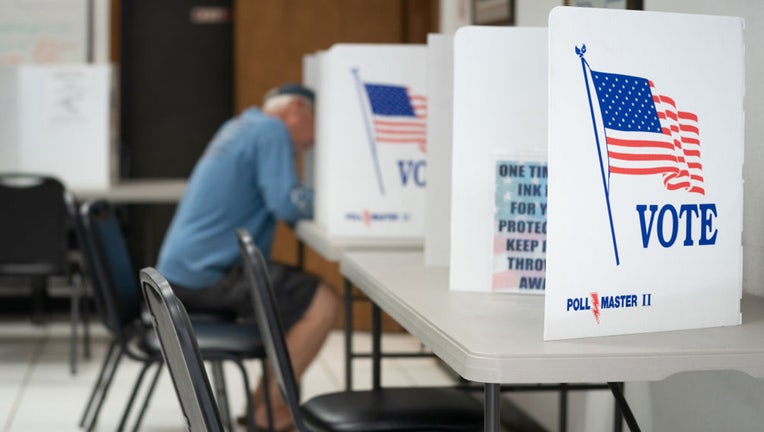
FILE - A man fills out a ballot at a voting booth. (Sean Rayford/Getty Images)
OAKLAND, Calif. - Hawaii’s Democratic Governor on Thursday signed into law a bill to stop corporations and "dark money" groups from spending unlimited amounts of money on politics.
The Aloha State’s S.B. 2471 states that because governments grant a corporation its powers, Hawaii can simply decline to grant the power to spend on elections. The new law goes into effect on July 1, 2027.
Big money
The backstory:
Proponents say the law circumvents the 2010 Supreme Court decision that opened the door for corporate spending on elections. Commonly referred to as "Citizens United" — the name of the nonprofit organization involved in the case — the court’s ruling stated that limiting corporate funding of independent political broadcasts was a violation of the first amendment.
The case opened the door for corporations and unions to spend unlimited funds on an election, so long as they don’t donate directly to political campaigns. In practice, that translates to funding organizations not affiliated with a candidate, often in the form of a TV ad.
The source of those funds is often unknown, preventing voters from understanding who is promoting a given political message.
Following the Citizens United decision, the reported independent expenditures of outside groups grew from $144 million in 2008 to $4.21 billion in 2024, as reported by campaign finance watchdog group OpenSecrets.
Hawaii’s new law does not attempt to regulate the power granted to a corporation by the Citizens United decision. It addresses whether a state is required to grant them spending power in the first place.
The law applies equally to companies founded and based in Hawaii and those that operate in the state but are registered elsewhere.
Similar legislation
Big picture view:
Hawaii is not alone in its effort to get corporate money out of politics. A group of volunteers in Montana is gathering signatures in hopes of putting similar legislation, the Transparent Election Initiative, on that state’s ballot in November. A lawsuit challenging the measure as unconstitutional was rejected by the Montana Supreme Court on April 1.
Legislators in over a dozen other states have introduced similar bills in 2026, though none have advanced.
Origins
Dig deeper:
Hawaii’s legislation is based on the legal theory Corporate Power Reset, published last year by Washington, D.C.-based progressive thinktank The Center for American Progress.
"When a state exercises its authority to define corporations as entities without the power to spend in politics, it will no longer be relevant to discuss whether the corporations have a right to spend in politics, because without the power to do so, the right to do so has no meaning," the document states.
The Source: The Associated Press, The Center for American Progress, OpenSecrets