

Why these California counties are directly funding immigrant legal defense amid Trump’s crackdown
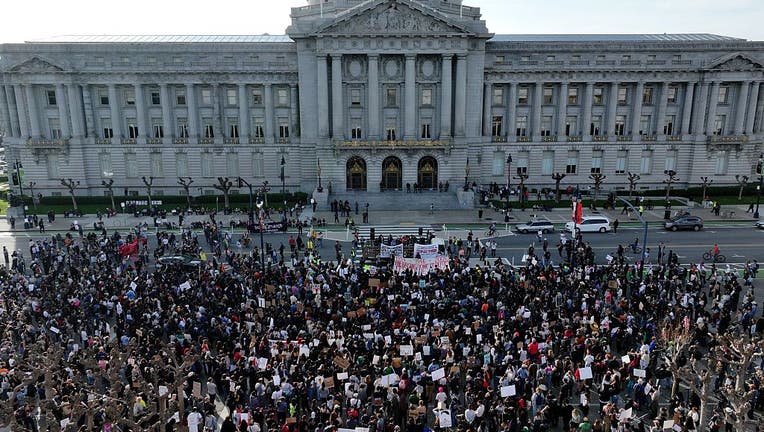
Thousands of students, workers and anti-ICE protesters are gathered at Dolores Park and marched to the City Hall as they show solidarity with Minneapolis in protest for ICE operations cross-country, in San Francisco, California, United States on Janu
OAKLAND, Calif. - With the Trump administration escalating immigration enforcement, several California cities and counties are setting aside public funds to help immigrants build legal defenses and support rapid response networks.
San Francisco and Alameda County are among the latest to designate additional money for immigrants facing deportation.
In October, after President Donald Trump threatened to increase Immigration and Customs Enforcement operations in the Bay Area, the San Francisco Board of Supervisors unanimously approved $3.5 million to bolster its defense fund. In March, Alameda County doubled the fund it had launched with $3.5 million.
Richmond, Los Angeles and Santa Clara County have also established immigration defense funds. In addition, Bay Area cities have joined forces to create the Stand Together Bay Area Fund, a legal resource fully funded by philanthropy.
Santa Clara County Supervisor Susan Ellenberg said protecting immigrants is in the county’s best interest, noting they make up 40% of the population.
"We have a direct nexus and concern to people who are working, living, raising families, paying taxes, participating in our community and keeping our economy and our social fabric strong," Ellenberg said. "So our local dollars are being spent to protect local interests."
Caitlin Patler, an associate professor at the University of California, Berkeley’s Goldman School of Public Policy, said the funds are necessary given the size of the immigrant population and what she described as the punitive nature of immigration courts.
"I don’t think that anyone should be representing themselves in any courtroom when the government comes with an attorney every time," she said.
Unlike criminal cases, deportation proceedings are held in civil court, meaning those facing removal do not have the right to a court-appointed attorney. The consequences, however, can be life-altering.
"Immigration judges have said these cases are like adjudicating life sentences in a traffic court setting," Patler said.
Legal funds predate Trump
Local government investments in immigrant defense funds are not new and predate Trump’s presidency.
In 2013, New York City became the first major city to implement a pilot legal defense fund for immigrants after the Obama administration increased enforcement. San Francisco launched a similar program the following year.
A 2014 study by the Northern California Collaborative for Immigrant Justice found that immigrants represented by lawyers from Bay Area nonprofits won 83% of their removal hearings, significantly higher than those without representation. Still, two-thirds of detained immigrants lacked access to legal counsel.
California established the Immigrant Assistance Program in 2015 after the Obama administration expanded the Deferred Action for Childhood Arrivals program. Known as "One California," the $45 million fund supports nonprofits that provide services, including legal help, to immigrants. The program bars funding for individuals convicted of a serious felony.
The fund has been included in the state budget annually, though debate has arisen over whether immigrants with felony convictions should qualify for assistance. Last year, Gov. Gavin Newsom signed a budget bill that some immigrant advocates criticized as too restrictive, saying it appeared to expand the list of felony offenses that would disqualify someone from state-supported legal aid. Newsom’s position aligned with Republicans who sought to tighten access to the fund.
While immigrant defense funds began more than a decade ago, the trend accelerated after Trump’s first election in 2016, when he campaigned on tougher border enforcement and reduced immigration.
Soon after Trump’s inauguration in 2017, Los Angeles launched a public-private effort to support immigrants facing deportation. The $10 million Los Angeles Justice Fund, started by former Mayor Eric Garcetti, was expanded in 2022 to create RepresentLA, an ongoing investment by the city, county and philanthropic organizations.
Increased funding after Trump’s reelection
A month before Trump’s second presidency, Santa Clara County allocated $5 million to support response activities tied to immigration enforcement. Since then, it has increased that amount to $13 million.
Ellenberg said Santa Clara’s fund is broader than most, supporting a range of immigration resource organizations, including the Rapid Response Network, along with legal defense, outreach, education and prevention efforts.
In September, San Francisco Mayor Daniel Lurie appeared with the mayors of Oakland and San Jose to announce the Stand Together Bay Area Fund, which aims to raise $10 million to support immigrant families affected by detentions and deportations. The fund is managed by the nonprofit San Francisco Foundation and does not include public money.
"My understanding is that their role is to support fundraising," foundation spokesperson Rachel Benditt said of the cities. "I do not believe that they will be donating money from the city budgets."
In a news release, Oakland Mayor Barbara Lee said the fund will pool resources from individuals, corporations, faith groups and philanthropic partners to support nonprofits working with immigrant communities.
Three Alameda County supervisors are contributing discretionary district funds to the effort. Supervisor Nikki Fortunato Bas said she plans to donate $50,000.
"These dollars are one piece of a much larger fight," Bas said in a statement. "A fight for dignity, for rights, and for the future of our democracy."
This story was first reported by CalMatters and is part of "The Stakes," a journalism project by UC Berkeley focused on executive orders and actions affecting Californians and their communities.