

Young Americans are less likely to follow politics or think voting is important: Poll

Impact of celebrity endorsements in politics
Ellis Cashmore, author of "Celebrity Culture," joins LiveNOW's Christina Evans to examine how celebrity endorsements for political candidates affect elections.
WASHINGTON - A new poll reveals that young adults are less engaged with U.S. politics than older Americans and are less likely to say voting is important.
The poll, which was conducted by The Associated Press-NORC Center for Public Affairs Research, surveyed more than 1,400 adults between July 10-14.
Young adults less likely to think voting is important, poll shows
By the numbers:
The survey found that young people — even those who follow politics closely — were less likely to say issues such as the economy, government spending and health care were "extremely important" to them than comparable older adults.
In another sign of their general estrangement from politics, the poll showed that young adults were more likely to reject political party labels. About one-third of adults under age 30 identified as political independents who don’t lean toward either major political party, compared with 17% of Americans age 60 or older.
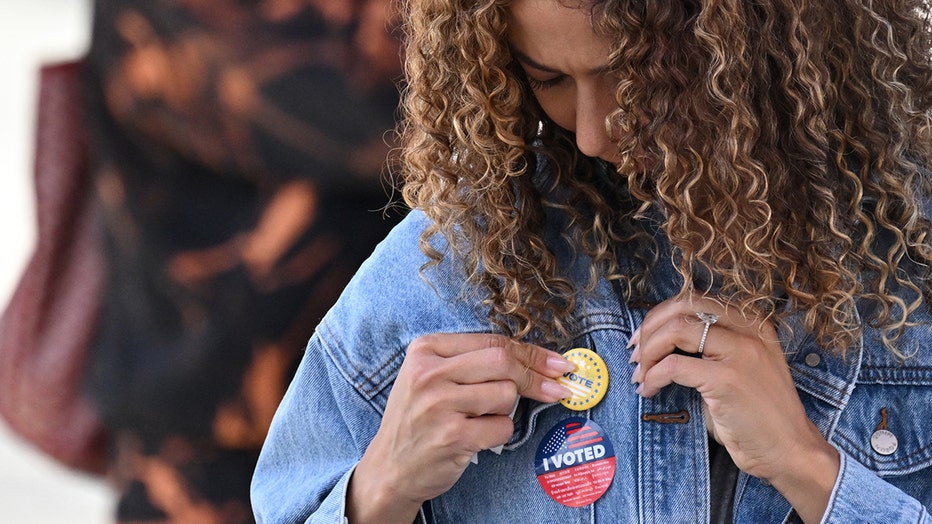
A young woman attaches a pin to her jacket after voting at a mobile outdoor vote center at SoFi Stadium in Los Angeles, California, on Election Day, November 5, 2024. (Credit: ROBYN BECK/AFP via Getty Images)
The poll also found that young people were far less likely to follow politics closely than older adults were, with only about 2 in 10 of adults under age 30 saying they followed U.S. politics "extremely" or "very" closely, compared with about one-third of Americans overall.
What they're saying:
"If another party was likely to win, I’d be interested in that," Mirekk Griffiths, who voted for Democrat Kamala Harris in last year’s presidential race but, like many his age, does not see voting as that valuable, told AP.
"I can’t say either way that voting matters," Griffiths said. "It’s just picking the least bad option. That’s what I remember my whole life — both sides are bad, but this side is less bad."
Disengagement from politics even higher in women, teens
Dig deeper:
In addition, young women were less likely than young men to say they followed politics. About one-quarter of men under 30 said they follow politics "extremely" or "very" closely, compared with 16% of women in the same age group. And about 4 in 10 young women said they followed U.S. politics "not very closely" or "not closely at all" compared with about a quarter of young men.
In another AP-NORC poll from May, disengagement was even higher among teenagers, with 44% of teens ages 13 to 17 reporting they followed U.S. politics "not very closely" or "not closely at all."
RELATED: Gen Z American details 'struggle to survive' in viral rant: 'I cannot afford to live'
To note, younger people are traditionally less likely to vote than older people, and voter participation tends to go up with age. It’s possible that engagement with politics could follow a similar pattern.
Despite the findings, Alberto Medina, who leads the Center for Information and Research on Civic Engagement at Tufts University, which studies youth and politics, noted that turnout among young people hit record levels in the 2020 election and was high last year.
"There’s a sense that democracy isn’t working for young people. There’s a lack of belief that democracy is even able to improve their lives," Medina said to AP. "At the same time, we have been living in an era of high youth voting."
The Source: The information for this story was provided by a poll conducted by The Associated Press-NORC Center for Public Affairs Research, which surveyed more than 1,437 adults between July 10-14. The Associated Press contributed to this story. This story was reported from Los Angeles.