

Groundbreaking blood test can detect more than 50 cancers, Bay Area biotech says
Menlo Park-based GRAIL said its recent findings showed its Galleri test detects seven times as many cancers when added to standard of care screening. (GRAIL)
MENLO PARK, Calif. - A Bay Area biotech company is behind a potentially groundbreaking blood test that promises to be a game-changer in cancer detection, with the ability to discover more than 50 types of cancer even before symptoms appear.
Menlo Park-based GRAIL said its multi-cancer early detection (MCED) test, Galleri, can find some of the deadliest cancers that aren’t a part of regular screenings.
Those regular screenings include tests for breast, colorectal, lung and prostate cancers.
But GRAIL officials said there are a host of cancers that aren’t a part of routine evaluations.
"Unfortunately, about 70% of cancer deaths occur due to cancers we're not looking for at all," Dr. Josh Ofman, GRAIL president, explained in a video describing the test’s success.
By the numbers:
The company said that studies showed that adding Galleri to the recommended cancer screenings resulted in a more than seven-fold increase in the cancer detection rate.
"Remarkably, roughly half of the Galleri detected cancers were found at an early stage," Ofman said. "And the test is especially sensitive to many of the deadliest cancers in early stages, like pancreatic, liver, and ovarian cancer."
SEE ALSO: Universal cancer vaccine could be coming, researchers say
This month, GRAIL released findings of its latest research which involved almost 36,000 adults 50 years and older, across the U.S. and Canada. The participants had no clinical suspicion of cancer.
Within 12 months after the blood draw, the company said the test was able to correctly identify almost 74% of the 12 cancers responsible for two-thirds of cancer deaths in the U.S.
Those deadliest cancers were identified as anal, bladder, colon/rectum, esophagus, head and neck, liver/bile duct, lung, lymphoma, multiple myeloma, ovary, pancreas, and stomach.
For all cancers, Galleri correctly identified more than 40%, according to the company's findings.
The false positive rate was 0.4%, which GRAIL said was the lowest of any available multi-cancer early detection test.
More than 53% of the new cancers detected by Galleri were stage I or II, and almost 70% were detected at stages I-III, the biotech company said.
Big picture view:
Cancer is the second leading cause of death after cardiovascular disease.
According to the American Cancer Society, about 1,700 lives are lost to cancer in the U.S. every day.
GRAIL said its blood test can help prevent many of those deaths, through early detection.
The biotech firm added that its blood test could help to minimize exposure to radiation and prevent unnecessary procedures.
Early detection has shown to improve cancer outcomes and can save lives.
"The earlier a cancer is caught, the easier it is to treat, and the better the outcomes are likely to be," according to the Cancer Research Institute.
How it works
The Galleri test works by identifying DNA in the bloodstream shed by cancer cells.
GRAIL explained that cancer can stay hidden in the body for months, but many cancers can leave DNA "clues" in the blood.
"The DNA fragments act like a unique fingerprint of cancer," according to the company, which noted that’s why it can detect cancers before symptoms appear.
But the company noted that not all cancers can be detected in the blood.
GRAIL also stressed that the test does not predict future genetic risk for cancer.
Providing a ‘roadmap’
What makes Galleri different from other MCEDs on the market is that the product can also provide doctors with a roadmap to indicate where in the body the cancer may be, the company said.
"If a cancer signal is detected, Galleri can give direction on the cancer's origin to guide an efficient diagnostic workup," according to Ofman.
The company’s research also found the test was able to provide a cancer signal of origin with a greater than 90% accuracy.
Galleri does not detect a signal for all cancers.
Who should use the test?
GRAIL said its test is recommended for adults facing an elevated risk for cancer, including those 50 years and older.
It’s not recommended for people 21 and younger, those undergoing cancer treatment, and pregnant women.
The American Cancer Society said there's still much research to be done on the future use of tests like Galleri, and there were currently no official recommendations or guidelines for using multiple-cancer detection tests.
"It’s not yet clear if MCD tests will be best used for general cancer screening, or for specific groups, such as people at higher cancer risk because of age, sex, family history, exposures, or other factors," the nonprofit explained. "A person’s life expectancy or their willingness and ability to follow up on test results might also matter."
False positive and false negative results do occur.
GRAIL said its product should not be a replacement for regular cancer screening, rather it should be used in addition to the screenings recommended by your health provider.
Most ‘rigorously’ researched
The company touted the extensive research behind Galleri, noting it has been tested in more than 380,000 clinical trial participants, making it "the most rigorously studied MCED."
GRAIL said since it emerged on the market as the first multi-cancer early detection test in 2021, it has conducted an additional 370,000 tests.
Availability and costs
Galleri tests are currently available at a cost of $950, and a doctor’s prescription is required.
The American Cancer Society said currently, most insurance plans do not cover the cost of multiple-cancer detection tests.
"Additional testing that may be recommended if an MCD test result is positive can also be costly, and it’s not yet clear if insurance would cover these costs," the cancer research and patient advocacy group said.
Not FDA approved
The product has not received FDA approval as it’s currently classified as a laboratory-developed test, under the Clinical Laboratory Improvement Act.
What's next:
The company said it will seek FDA approval in the second half of next year, with plans to submit Galleri as a medical device.
The American Cancer Society said that MCED tests are a promising advancement as they might be a key to finding a wider range of cancers that don't have proven screening tests.
But the group said further studies need to be conducted.
"More research is needed before these tests can be recommended for widespread use in people with no symptoms of cancer," the health organization said, adding, "Because there are so many uncertainties about MCD tests, it’s important that you talk with your doctor about whether testing is right for you."
GRAIL said its cancer test has shown strong success as a proactive and potentially life-saving tool.
"Annual Galleri screening is simply a game-changer for cancer detection," Ofman said, "helping adults at elevated risk for cancer such as those 50 and over, find aggressive cancers earlier, and giving them more control over their health."
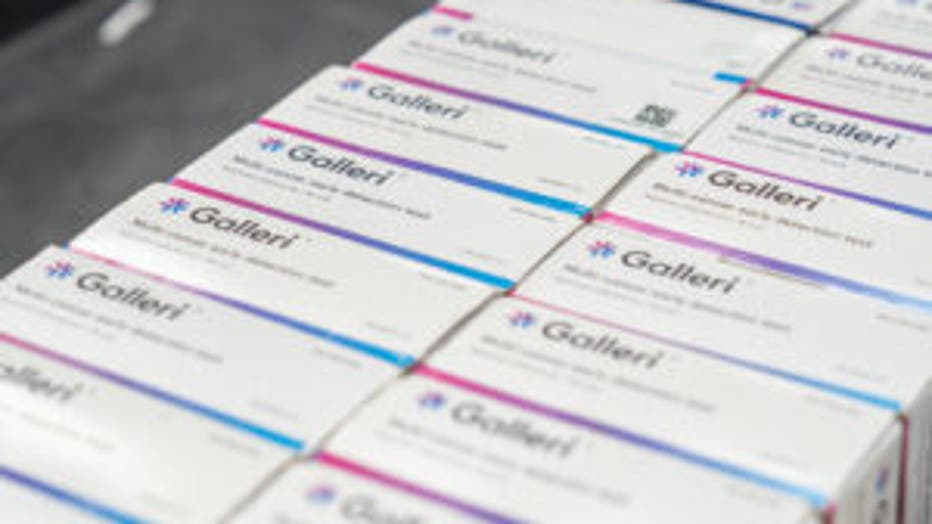
Menlo Park-based GRAIL said its Galleri test can detect more than 50 kinds of cancer. (GRAIL)

Doctor stresses importance of early detection during this Breast Cancer Awareness Month
October is Breast Cancer Awareness Month, and there is a heavy focus on the power of early detection. 1 in 8 women will be diagnosed with breast cancer in their lifetime, according to the American Cancer Society. Dr. Dawn Nwamuo, a radiologist and breast imaging specialist at Kaiser Permanente San Leandro, joined us on 'The Nine,' to discuss why catching it early can make all the difference.