

July was hottest month on Earth, scientists say
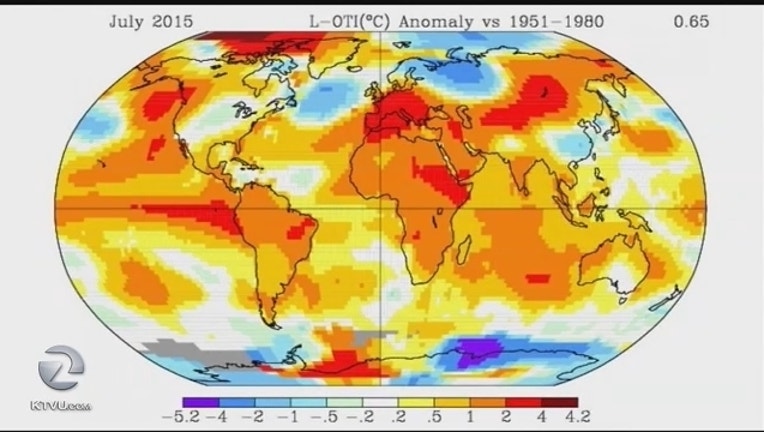
WASHINGTON - For planet Earth, no other month was as hot as July in records that date to the late 1800s, according to the National Oceanic and Atmospheric Administration.
And the globe is well on its way to having its hottest year on record.
The NOAA, NASA, and the Japan Meteorological Agency have published data that show it was the hottest July on record. Since July is on average the planet’shottest month, temperatures last month likely reached their highest point in the history of instrumental records.
NOAA calculates that July’s average global temperature of 61.86 degrees was 0.14 degrees warmer than the previous warmest month, July, 1998.
“It just reaffirms what we already know: that the Earth is warming,” said NOAA climate scientist Jake Crouch. “The warming is accelerating, and we’re really seeing it this year.”
The average temperature for Africa was the second highest for July on record, behind only 2002, with regional record warmth across much of eastern Africa into central areas of the continent. Record warmth also was observed across much of northern South America, parts of southern Europe and central Asia, and the far western United States, NOAA reported.
While the western states baked, however, Toledo and much of the surrounding area were cooler and wetter than normal for a second straight month.
The average daily mean temperature at Toledo Express Airport — the metro area’s official reporting station — was 70.7 degrees, 2.8 degrees cooler than normal, while the 6.16-inch rainfall was 2.93 inches wetter than normal and the eighth-wettest July since record-keeping began in 1873.
Normal is based on a 30-year average from 1981 through 2010, according to the National Weather Service.
June also was cooler than normal for Toledo and was the fourth-wettest for thatmonth in the city’s history.
In NASA’s global analysis, every month this year has ranked among the top four warmest, including back-to-back warmest months on record in June and July.
It is almost inevitable that 2015 will be the warmest year on record, beating out 2014.
Given that the temperatures have been so high already — especially the oceans, which are slow to cool — NOAA climate scientist Jessica Blunden said she is “99 percent certain” that 2015 will be the hottest on record for the globe.
The oceans would have to cool dramatically to prevent it, and they are trending warmer, not cooler, she said.
NASA has observed the tell-tale signature of the powerful El Nino event — the much-warmer-than-normal sea surface temperatures in the eastern and central tropical Pacific.
These warm waters boosted the average global ocean temperature to its warmest level on record during July, 1.35 degrees above normal. That difference from normal is the largest ever recorded in any month for the global ocean, NOAA said.
The heat from El Nino most likely elevated temperatures in other areas because of its effects on global weather patterns.
The heat hit hard in much of Europe and the Middle East.
It was the hottest July in Austria since records began in 1767. Parts of France had temperatures that were on average 7 degrees above normal. Temperatures broke 100 in the Netherlands, which is a rarity.
Nine of the 10 hottest months on record have happened since 2005, according to NOAA. Twenty-two of the 25 hottest months on record have occurred after the year 2000. The other three were in 1998 and 1997.
This shows that despite what climate-change doubters say, warming has taken no rest since 1998, Ms. Blunden said.
Meanwhile, a study released on Thursday says human-caused global warming is worsening California’s drought.
The study by Columbia University’s Earth Institute is the first to measure warming’s impact on the drought, predicting that it increased the problem by as much as 25 percent. Weather patterns that push away the rain-carrying moisture in the atmosphere are normal. But warming adds to the dryness and heat. Some of the moisture stored in plants and the soil evaporates into the drier atmosphere.
This drought is the most severe on record, state officials say, and 2014 was the hottest year in state history.
Californians are hoping that the giant El Nino forming in the Pacific will deluge the state with rain next winter. But researchers have said that will just delay longer and more frequent droughts.