

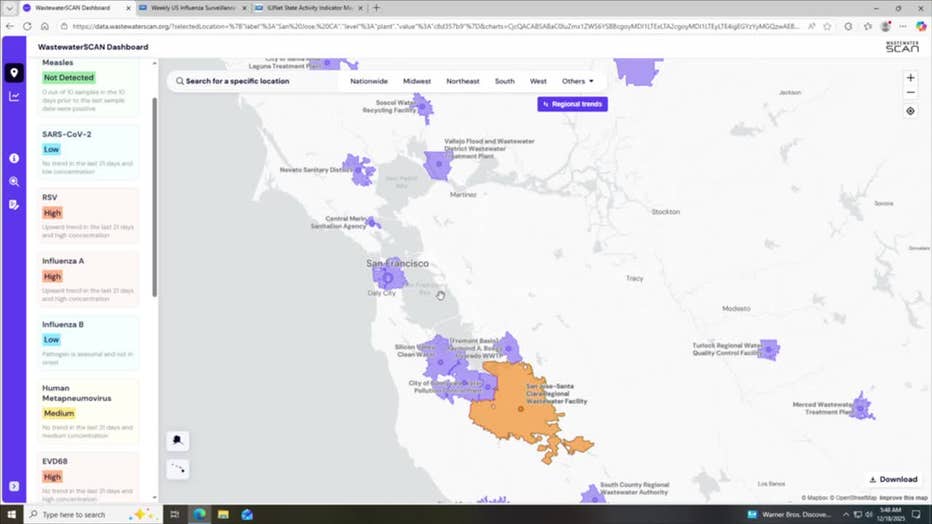
Map: Here are the Bay Area hot spots for the flu

Bay Area flu cases on the rise
Flu cases are climbing across the San Francisco Bay Area, and health officials say new wastewater data shows influenza activity is already elevated — particularly influenza A — weeks before many people seek testing or medical care.
OAKLAND, Calif. - Flu cases are climbing across the San Francisco Bay Area, and health officials say new wastewater data shows influenza activity is already elevated — particularly influenza A — weeks before many people seek testing or medical care.
Public health researchers at Stanford University track the spread of infectious diseases through a tool called WastewaterSCAN, which analyzes samples from water treatment plants across the region. Medical experts say the data provides an early warning signal, detecting viruses even before people show up at clinics or hospitals.
According to the latest results, influenza A — a common strain of seasonal flu — is showing up at high levels in Bay Area wastewater. Hotspots include San Jose, Palo Alto, Fremont, San Francisco and parts of the North Bay, stretching from San Rafael to Vallejo.
"What you see in the San Francisco Bay Area won’t necessarily be the same as what you see in New York City or Miami," said Dr. Woodrow Myers, chief strategy officer for the Wellness Equity Alliance and a former chief health officer for Indiana and New York City. "Each area experiences different levels of intensity."
California Department of Public Health data backs up the wastewater findings. Reported positive flu tests in the Bay Area nearly doubled in the week following Thanksgiving, from 394 to 659 cases from Nov. 29 through Dec. 6, the latest week data was available, signaling a sharp rise in transmission.
Doctors say the most important step people can take right now is getting vaccinated.
Each year’s flu vaccine is developed months in advance, based on global surveillance and predictions about which strains will circulate. While no vaccine offers perfect protection, Myers said this year’s flu shot appears to be a good match for the strains now spreading.
"The good news is that this year’s vaccine includes protection against the influenza A strain we’re seeing," Myers said. "It’s not perfect, but what it does is take the illness from what we call ‘wild to mild.’ People who are vaccinated tend to have a much milder illness and are sick for a shorter period of time."
Flu season typically runs from October through April, with cases often peaking around mid-February. Myers said it is not too late to get vaccinated, even for people who have avoided illness so far.
Despite longstanding evidence supporting vaccines, Myers expressed concern about declining trust in public health messaging.
"There’s a lot of confusion today that’s been promoted by people who are supposed to be in charge of public health," he said. "That doubt should not be there. Vaccines are effective. I’ve seen it over decades of practice."
Some people report feeling sick after receiving a flu shot, which Myers said can happen but is uncommon.
"That reaction is a risk, but it’s worth it," he said. "I’d rather you lose a day in October than lose a week or more later in the season with a severe flu."
Looking ahead, Myers said it’s still too early to predict how severe this flu season will be, but he does not expect it to be mild. Vaccination rates, regional differences and circulating strains will all play a role. "If you haven’t gotten your flu shot yet, now is the time," he said. "If you get it now, you can still be protected by the peak of the season."
Beyond influenza, wastewater data has also shown elevated levels of RSV, which now has vaccines available for older adults and some children. Norovirus, however, remains a concern with no vaccine available.
Public health officials are also monitoring other seasonal viruses. Wastewater sampling has shown an increase in norovirus — often referred to as the "stomach flu" — although levels in the Bay Area have begun to level off in recent weeks.
Norovirus can cause intense stomach upset, vomiting and diarrhea, typically lasting about 24 hours. While most people recover on their own, children and older adults are at higher risk of dehydration and, in some cases, hospitalization.
Unlike the flu, there is no vaccine for norovirus.
"For norovirus, handwashing with soap and water is key," Myers said. "Hand sanitizer helps, but it’s not the best defense."
Health experts say the expanded use of wastewater surveillance — a practice that grew during the COVID-19 pandemic — has become a powerful tool for tracking outbreaks and warning communities sooner.
"We’ve learned a lot in the past few years," Myers said. "When people pay attention to these early indicators and take action, it helps protect not just themselves, but their families and their communities."