

Prop. 40, California's 'billionaire tax' fails at the ballot box
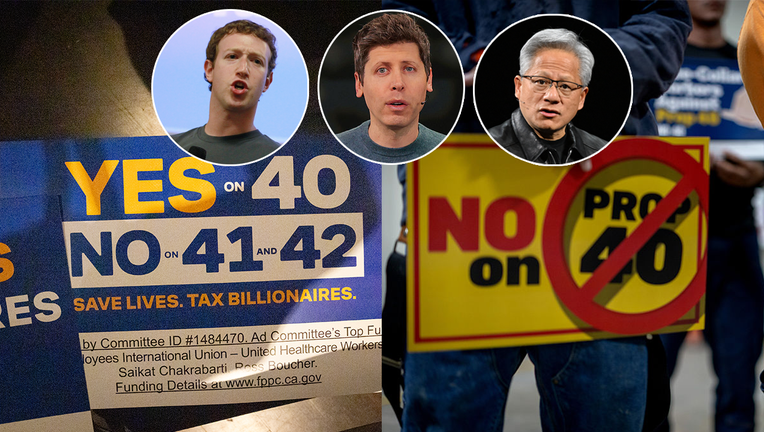
Prop 40 billionaire's tax
OAKLAND, Calif. - The campaign to defeat Proposition 40 was, in the weeks before Election Day, spending $1 million a day to convince voters not to adopt the one-time tax on billionaires' assets.
That investment paid off at the polls — results show 52.8% of voters rejected the would-be tax.
Had it passed, Prop. 40 would have imposed a one-time 5% tax on the estimated 200 Californians whose net worth exceeds $1 billion. The proposition would have raised roughly $100 billion over five years, and the funds would have been largely spent on healthcare, with some money going toward food assistance and education.
For and against
The backstory:
The item was introduced by a quartet of academics as a means to counteract the Medi-Cal budget cuts enacted by President Donald Trump’s "One Big Beautiful Bill Act," which passed in 2025 and cut $100 billion in California’s healthcare funding to pay for tax breaks for the wealthy.
Proponents argued that the tax is necessary because the state’s ultra-wealthy benefited most from the tax breaks. Prop. 40 was supported by the Service Employees International Union—United Healthcare Workers West, Senator Bernie Sanders, the American Federation of State, County and Municipal Employees, The California Democratic Party, and California Teamsters union, among others.
The proposed one-time tax proved divisive though, and drew opposition from a range of stakeholders, including Gov. Gavin Newsom, the California Teachers Association, Planned Parenthood, the California Medical Association, and California Professional Firefighters.
Big spenders
By the numbers:
The state’s wealthiest residents also threw their support behind the campaign to defeat the measure. Palantir CEO Peter Thiel (estimated net worth $35.3 billion), former Google CEO Eric Schmidt (net worth $65.1 billion), DoorDash CEO Tony Xu (net worth $1.7 billion), Stripe CEO Patrick Collison (net worth $17.5 billion), and Google co-founder Sergey Brin (estimated net worth $231 billion) all donated heavily to the campaign.
Opponents argued that the tax would cause billionaires to flee California for a more tax-friendly state, and take their wealth with them, which would ultimately reduce the state’s tax revenues.
Meta CEO Mark Zuckerberg, whose net worth is estimated to be approximately $240 billion, made headlines in the weeks leading up to the election with the announcement that he would likely leave California if the tax passed. Meta responded by announcing a plan to create a new class of company shares that would allow Zuckerberg to sell up to half his financial stake in the company without giving up voting control.
Other measures
Dig deeper:
In addition to funding the "no on 40 campaign," opponents also introduced two ballot measures that, had they passed, would have nullified Prop. 40.
Proposition 41, called the "Improving Transparency, Effectiveness and Efficiency in California Government Act," would have required the state auditor to review programs funded by proposed special taxes before they appear on the ballot, and would have prohibited new state taxes from being exempted from a voter-approved state spending limit. Nearly 55% of California voters rejected the proposition.
Proposition 42 would limit the state’s ability to impose certain new taxes, specifically taxes on "retirement holdings, individually-owned assets, and other forms of personal savings. It would have also barred retroactive taxes on past earnings unless the state is using that revenue to respond to emergencies such as fire or flood. The proposition passed with 52% of the vote.
The Source: Information for this story was gathered from CalMatters, Bloomberg, Forbes, and previous KTVU reporting