

Rally to force ICE to unmask, show ID in San Jose

Rally to require ICE to unmask faces in San Jose
Several San Jose councilmembers will host a press conference and rally to announce and advocate for a new policy that would prohibit federal Immigration and Customs Enforcement agents from concealing their identity or covering their faces with masks during enforcement activities in San José.
SAN JOSE, Calif. - Four of 10 San Jose city councilmembers are pushing for the city to adopt a new policy that would prevent federal ICE agents from hiding their faces with masks during enforcement in activities in the city – but there are legal questions on whether the mandate could be enforced.
ICE unmasking proposal
Councilmembers Peter Ortiz, David Cohen, Pamela Campos, and Rosemary Kamei, are planning a rally on Wednesday afternoon ahead of a Rules Committee hearing to advocate for their proposal.
They will be joined by Huy Tran, executive director of Services Immigrant Rights and Education Network, or SIREN; Misrayn Mendoza, organizing manager of Amigos de Guadalupe; and Lucila Ortiz, political director of Working Partnerships.
Their policy would require ICE agents to display official identification during all operations conducted in San José and forbid the use of masks or face coverings by ICE agents unless explicitly required for health or safety reasons.
If approved by the City Council, the councilmembers said San José would become one of the first cities in the nation to formally restrict federal ICE practices in this way.
"Families in my community should not live in fear of masked agents carrying out actions in secrecy," Ortiz said in a statement ahead of the rally. "By requiring federal agents to disclose their identity, we are protecting our residents, restoring trust, and making it clear that San José stands with its immigrant families."

Other cities
This unmasking effort is playing out in other cities nationwide, as well as at the federal and state level.
In July, U.S. Sen. Cory Booker (D-New Jersey) and Alex Padilla (D-California) introduced the Visible Identification Standards for Immigration-Based Law Enforcement Act, which they said would strengthen oversight, transparency, and accountability for the Trump administration’s "indiscriminate and alarming immigration enforcement tactics that have terrorized communities across California and the nation."
And in California, senators Sen. Scott Wiener and Renée Pérez have introduced two bills — SB 627, the No Secret Police Act, and SB 805, the No Vigilantes Act — to essentially demand the same thing from ICE officers working in the state.
Federal government free from state regulation
But an analysis by legal counsel for the Assembly Committee on Public Safety found that Wiener’s bill faces legal challenges, most importantly that "the activities of the federal government are free from regulation by any state."
In June, when Wiener introduced the idea, Harmeet Dhillon, a Republican San Francisco lawyer who is now a Department of Justice attorney for the Trump administration, wrote on X: "Scott, go check with a lawyer if this is a thing, and get back to us. (Hint — it isn’t — states can’t regulate what federal law enforcement wears)."
But then, in August, a settlement was reached in federal court stemming from a 2020 case that now requires ICE agents, at least in the Los Angeles Field Office, to wear visible identifiers on their clothing so as not to trick community members to think they are local or state police.
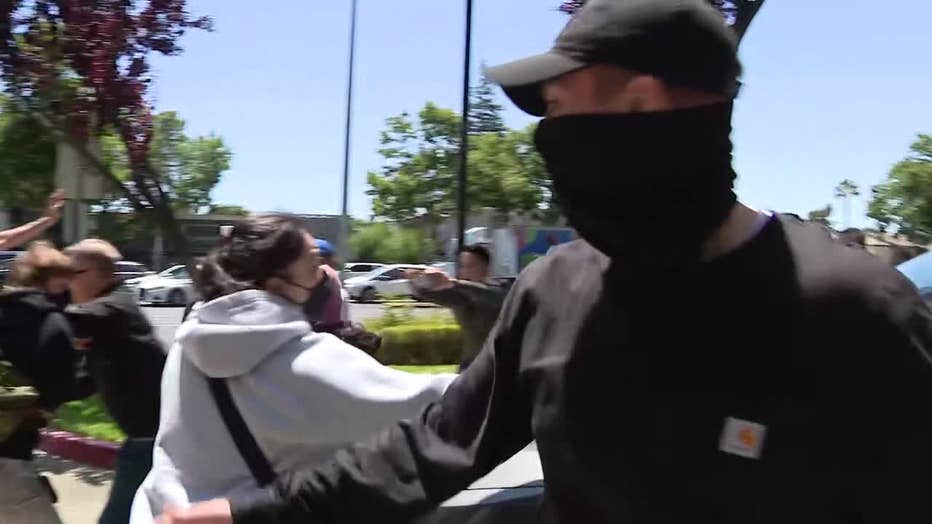
Federal agents took a man into custody and fought off protesters outside immigration court in Concord. The operation was conducted by ICE, FBI and IRS agents. June 11, 2025
California police, Trump don't like
On top of the legality issues, two large police associations in California are against the idea, saying there are already laws that mandate officers in the state clearly identify themselves.
Peace Officers Research Association of California president Brian Marvel has previously said that California already has oversight measures to ensure that officers can be identified and held responsible for their actions, Marvel said, including language in the state's penal code which requires uniformed officers to wear a badge, nameplate or other device which clearly displays their ID number or name.
And Jason Salazar, head of the California Police Chiefs Association, echoed that thought: "It's not local law enforcement that's engaging in those tactics. This bill would make it harder to do that."
Trump administration officials have consistently defended the practice, saying that immigration agents have faced strident and increasing harassment in public and online as they have gone about their enforcement in service of Trump’s drive toward mass deportation, and hiding their identities is for their and their families’ safety to avoid things like death threats and doxing, where someone’s personal information is released without their permission on the internet.
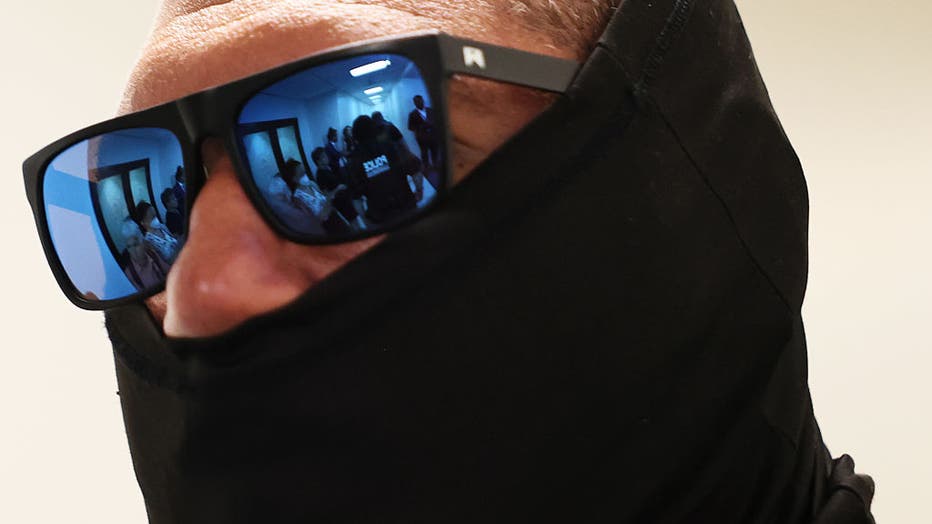
Federal agents wearing masks patrol the halls of immigration court at the Ted Weiss Federal Building on July 09, 2025 in New York City. (Photo by Michael M. Santiago/Getty Images)
Two sides of masking
Geoffrey Stone, a University of Chicago law professor, said the U.S. Supreme Court has made clear that the right to free speech includes the right to speak out anonymously. But he said how it should apply to protesters wearing masks remains "an unresolved First Amendment question."
For Stone, that raises a key question: Why should protesters and ICE agents be subject to different rules?
"The government doesn’t want them to be targeted because they engaged in their responsibilities as ICE agents," Stone said. "But that’s the same thing as the argument as to why you want demonstrators to wear masks. They want to wear masks so they can do their ‘jobs’ of engaging in free speech properly. The same rationale for the officers wearing masks should apply to the protesters."
Federal law requires ID
However, in an August post by the Center for American Progress, authors point out that federal law enforcement officers must adhere to certain laws, which civilian protesters do not.
By law, "only designated immigration officers are authorized to make an arrest," and they are required to identify themselves as an immigration officer as soon as it is "practical and safe."
The authors of this post noted that in several cases across the country, the immigration officers making arrests have failed to identify themselves or their agency, even when asked directly, potentially violating this provision.