

San Jose man's conviction overturned based on prejudicial rap lyrics: court
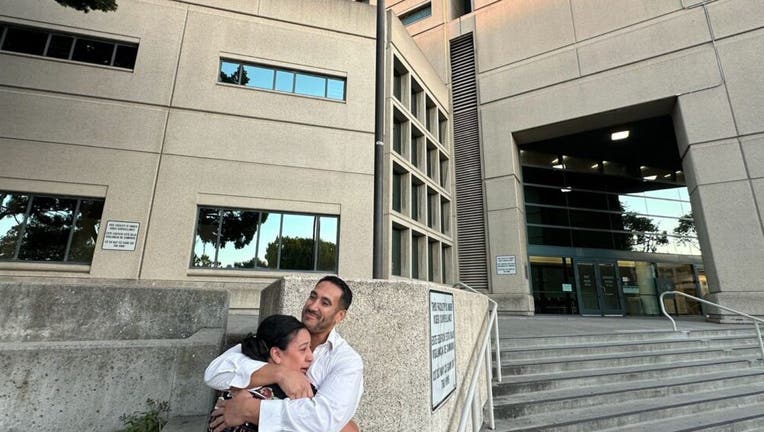
Hugo Chavez embraces a loved one upon his release from Santa Clara County jail on July 23, 2025. Photo courtesy of Hugo Chavez via San Jose Spotlight
SAN JOSE, Calif. - A San Jose man was released from jail last week after state judges lambasted Santa Clara County prosecutors for using rap lyrics in an attempt to put him behind bars for more than a century.
A December state appellate ruling found prosecutors in District Attorney Jeff Rosen’s office prejudiced a jury during a retrial and muddied the bounds of permissible evidence by mentioning the defendant, Hugo Chavez, produced a rap song to convince jurors in closing arguments he was a gang member. The Sixth District Court of Appeals ruling also questioned the prosecution’s use of a witness who lacked credibility and testified to lying to police on various occasions.
"This case presents the rare circumstances under which reversal is warranted: The evidence against Chavez was not strong; the contents of the lyrics were extremely inflammatory; and the prosecution’s frequent references to them compel the conclusion that it is reasonably probable the outcome of the trial would have been more favorable to Chavez in the absence of the error," the ruling reads.
Chavez, 43, embraced friends and family outside the Santa Clara County Main Jail upon his July 23 release, after organizing by local activists Silicon Valley De-Bug. He spent 13 years in prison after he and a co-defendant were accused of hunting for and attacking two rival gang members in 2008. His first trial ended in a hung jury. Rosen’s office tried him again in a second trial that ended with Chavez, who had no prior felony history, receiving a 105-year prison sentence in 2019. County prosecutors were preparing for a third trial after the state ruling but dropped the case.
During the appeals process, Chavez’s lawyers argued the district attorney’s office used racially biased tactics that state lawmakers moved to eliminate through the Racial Justice Act of 2020 and new evidence codes restricting the use of creative expressions against defendants.
A spokesperson for Rosen’s office chalked the latest case dismissal up to difficulties trying old charges.
"Factors like the age of the case, availability of witnesses and the appeals court ruling made it problematic, if not impossible, to try this case at this time," the spokesperson told San José Spotlight. "We are disappointed but determined to hold those who commit gang violence accountable."
Public Defender Damon Silver lauded the decision to drop the charges.
"Using labels, especially ones that tap into community fears and complex ethnographic histories such as ‘gangs’ always risks producing injustice," Silver told San José Spotlight. "I applaud the district attorney’s office for reevaluating whether pursuing this prosecution was the right thing. I would encourage all of us as members of the criminal legal community to continue to reflect on how we can collectively increase just outcomes and identify practices from the past we should abandon."
Prosecutors alleged Chavez and a co-defendant were members of the Mob, a subset of the Norteño gang. They pointed to Chavez’s role in helping friends make rap songs about gang violence. But the appellate ruling found Chavez’s role in the songs was minimal. He did not write or perform them and most of the lyrics used as evidence against Chavez were written, recorded and published in 2004 or earlier — several years before the alleged offenses took place.
Chavez, who got to meet his daughter for the first time since his release, said he’s angry for having lost so many years of his life. He became an advocate for other incarcerated people while behind bars and wrote a letter to state lawmakers in support of the Racial Justice Act.
Chavez said he’s doubtful county prosecutors have learned from his case in order to crack down on gang violence without racial bias — and plans to continue advocating for criminal justice reforms in Silicon Valley.
"I was attacked because of where I was raised — where I grew up. It’s almost unbelievable how unfair the justice system is, and how lopsided the decision making is when deciding how evidence is used," Chavez told San José Spotlight. "I wouldn’t have been in this position if the system was fair."
This story was originally published in San Jose Spotlight.