

San Francisco honors atom bomb survivors on 80th anniversary

Two Hiroshima atom bomb survivors in SF honored at 80th anniversary ceremony
Jack Dairiki and Seiko Fujimoto were caught in Japan when the atomic bomb was dropped August 6, 1945. On Wednesday for the 80th anniversary, they were honored and shared their thoughts with KTVUs Jana Katsuyama about their hopes for peace.
SAN FRANCISCO - Eighty years after the world witnessed the first atomic bombs dropped in Japan, survivors of the bombing gathered at a ceremony in San Francisco's Golden Gate Park Japanese Tea Garden to commemorate the survivors and to call for peace.
Survivors of the atomic bomb
Jack Dairiki and Seiko Fujimoto, both "hibakusha" or survivors of the atomic bombing in Hiroshima, were honored at a Blessing Service for Peace.
Golden Gate Park has a connection to the Hiroshima bombings. Near the pagoda, city officials noted that the Japanese Tea Garden has two ginkgo tree saplings, taken from two trees that survived the bombing in Hiroshima. Guests were given seeds after the ceremony to plant, as a symbol that anyone can nurture the seeds of peace.
Dairiki and Fujimoto are both San Francisco residents who have shared their memories over the years with the community about the horrors of war that they witnessed as children.
Horrors of war
"The tragedy like the one that happened in Hiroshima must never, never happen again," said Yo Osumi, Consul General of Japan in San Francisco.
The ceremony near the tall pagoda included dignitaries from the San Francisco foreign consular corps, Chief of Protocol Penny Coulter, members of the Japanese American community, and the San Francisco Interfaith Council.
"Hibakusha"
Dairiki was just 14 years old, a middle school student, on the day the bomb was dropped in the morning of August 6, 1945. He says all the boys 15-years-old and older had been sent to war.
He was sent to work making rifles. Girls were also put to work testing the rifle sites, he said.
"We were forced to work for the war effort at a munitions factory in the station after Hiroshima," Dairiki said.
At 95-years-old, he still remembers that morning. A painting he drew years later in 1950 shows the mushroom cloud and the broken windows blasted out of the factory and other images from his memory as a teen.
"It all shattered, was flying over us," Dairiki said.
Dairiki says he walked 10 miles back to his home. He briefly caught a train, but one side was burned and the glass was shattered. Inside, he said people were injured, calling for help.
"There were a lot of people going out, some burned of course, and people in the neighborhood trying to help them," Dairiki said.
Seiko Fujimoto was also there as a child, whose relatives were among the estimated 60,000-80,000 people who were instantly killed by the A-bomb. The death toll was eventually estimated at more than 130,000 people after the second bomb was dropped on Nagasaki on August 9, 1945. Many people also died from radiation and injuries.
Hope for peace
These children of war are now in their 80s and 90s, and continue sharing their stories with young people.
Many hope people will remember the human toll, and work for peace.
"To think twice, three times about nuclear war and Hiroshima," Fujimoto said.
A second ceremony in San Francisco's Japantown was held later in the day, sponsored by the National Japanese American Historic Society and Genryu Arts.
Another ceremony is scheduled for Saturday August 9, 2025 in San Francisco's Japantown through the Nichibei Foundation to honor survivors of both Hiroshima and Nagasaki.
Featured
SF Japantown shops persevere despite 2-year construction and past setbacks
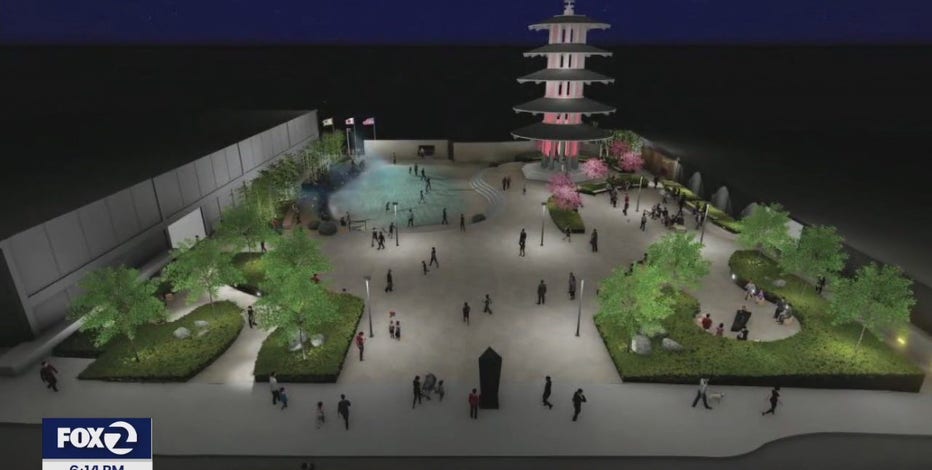
The Peace Plaza in San Francisco's historic Japantown is now in the midst of a major construction project, that will pose a challenge to businesses that remain open even as the renovation closes the plaza for an estimated two years.