

UC Berkeley dropouts launch dating service to 'kill Tinder with AI'
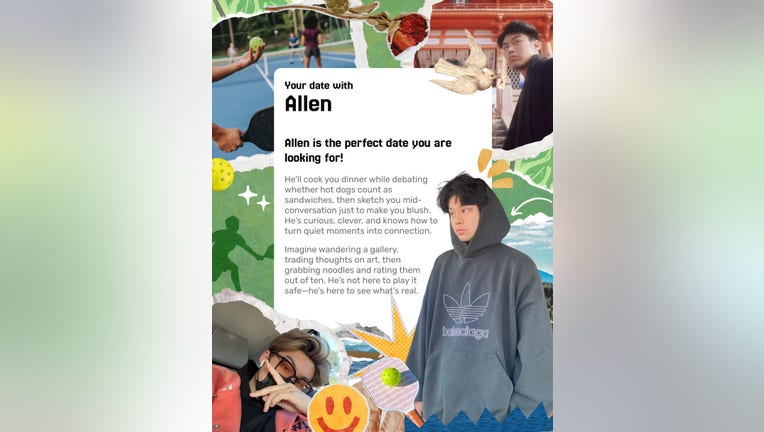
Allen Wang co-founded Ditto AI, a dating platform that uses artificial intelligence. (DITTO AI)
BERKELEY, Calif. - Two UC Berkeley dropouts have set out to shake up the online dating world, launching a new artificial intelligence-driven platform that seeks to get people off their dating apps and get out there for the in-person, real-life experience with their perfect match.
It’s called Ditto AI. There’s no swiping involved, no in-between messaging phase, and the whole experience is curated by artificial intelligence to make the physical face-to-face happen.
"Tell me your type, I set up the date," the website states.
And with one of the biggest objectives of AI being accelerated automation, Ditto AI promises to find that great match not just better than the traditional dating app, but exponentially quicker.
It’s motto: "Get your best IRL date 1000x faster."
Available on college campuses
Currently, the platform is available to college students at the University of California San Diego, UC Berkeley, and the University of Southern California, with plans to go nationwide and potentially worldwide. Ultimately, Ditto wants to be available as a tool for those outside of college or those seeking specific activity-based meet-ups.
As a dating platform, not only does it utilize AI to scour users’ profiles to pick a match, the technology takes it further to simulate conversations and "know when something clicks—before you do," according to Ditto AI’s manifesto on its website.
What they're saying:
"Our hypothesis is that you don't have to go out on like 500 bad dates to figure out which one is the best one. AI can do like 99% of it. You should only just go to this one, that is theoretically the best one," 22-year-old co-founder Allen Wang told KTVU.
In a world where there is heightened concern about how AI will prevent real-life human connections, the objective of Ditto AI seems like a paradoxical idea, but its founders say they’re using the technology to promote meaningful face-to-face moments.
"I feel like for me personally, a lot of my best connections are super spontaneous, and they're like serendipity kind of stuff. So we were like what if we can engineer serendipity for everybody to have access to higher-quality connections that, you know, they wouldn't have in the first place?" Wang proposed, adding, "Basically, we just want to help people to find whoever they wanna find you as easy as possible, and that what motivated us to build Ditto."
Date planner
Ditto AI also seeks to create the optimal setting to increase the probability of the matched couple hitting it off.
"We are helping to decide what activity to do. We are not only sending them like the person, but we also send like a scheduler for them to pick a time, and we send them the location that they should be meeting at because we use AI to write a lot of simulations of the interactions between the humans," Wang explained, adding, "We literally do all the work for our user, you literally just show up in real life. No swiping, no small talk, just show up."
How it works:
The AI technology, Wang said, makes for a much deeper, more precise match-making than other online dating sites.
"You simply tell us what you're looking for and your information. So for example, you can say, 'I'm at USC. I'm looking for like a 6’2" hot nerd who brings me flowers,' right? And then we will help you find a 6’2’ hot nerd who brings you flowers at USC," Wang explained.
The co-founder said the next step is to provide information to the parties, the specifics of their description, why the parties would vibe and what makes them a good match. Once the two sides decide to meet, Ditto then offers a planned date, giving the users a time and place to meet.
"We just tell you, ‘Hey you guys can meet 6 p.m. this Saturday at this café at USC Village.’ And then you simply just show up and then enjoy the actual in real-life connection, but we will also give you some dating tips." Wang shared.
Those tips can include asking questions based on information the user shared, like asking about the date's last trip overseas. And instead of just chatting about hobbies, like hiking, Ditto offers specific suggestions, like talking about what type of hiking shoes they like best.
The company’s founders said the technology also allows them to go more in-depth on the characteristics that make a match than the process used by traditional dating services.
"The underlying philosophy of using AI is to read through the superficial text of the people and then really go deeper into their personality. For example, maybe this girl, she's into hip-hop and this guy, he's into, I don't know, like, rock climbing," Wang proposed. "Even though those hobbies… hip-hop and rock climbing seem to be really irrelevant, but AI can tell you, both are very adventurous."
He said AI can get to the core of a person's interest, taking a more analytical approach on compatible attributes.
"So what matters actually is that you guys don't have to have the exact same hobbies. You guys can be different on the surface level, but you guys are similar in the core," the co-founder said. "And that's actually what makes a date good and that's what AI is bringing out on the table, beyond the superficial, just like hobby-level mashing but like intrinsic personality level."
SEE ALSO: 21-year-old Ivy League dropouts raise millions, launch Bay Area AI startup to 'cheat on everything’
AI can also be a tool to identify specifics on what physical attributes a person is looking for.
"Right now, there's no way for you to tell the app like ‘Oh, I want somebody with tattoo and piercing,’ because they simply cannot understand who has the tattoos, who doesn't have tattoos. But on Ditto it’s very straightforward… We just ask the AI, ‘Yo, like I'm looking for somebody with tattoos, and it can go through all the pictures because apps actually can't understand what's in the pictures," Wang said.
AI is used in multiple approaches to find the match, which helps to speed up the process.
"So it really brings this new way of understanding the user, whether it’s on the appearance level or is this, you know, the value deep down personality level," Wang said. "And we think by reaching this technology, we can save people a lot of time."
Not an app
The platform is not an app. Wang said consider it more like a friend who is sending you messages.
"The AI interacts with you in iMessage so it's almost like a friend that texts you different fun stuff to do in iMessage for you. So that way it is very natural," Wang explained, natural, like a pal telling you about a girl you might be interested in or places he might suggest you take that girl on a date.
‘IRL’ connections
And unlike apps, Wang and Ditto Ai co-founder Eric Liu set out to get people off their devices and into the real world.
"I think right now you know, especially after COVID, I think people are more distant. People are not walking up to each other. They are not approaching each other in real life," Wang said. "Everybody has fear of getting rejected. Everybody's like doom scrolling, TikTok doom scroll, Instagram, so that's also why we want to emphasize bringing people back in real life."
He said people are spending more time on their screens than interacting with one another face-to-face.
"Everybody right now easily will probably have like a six hour plus screen time. But if you think about it, if you spent like 10 hours, eight hours sleeping and then putting six hour screen time that's literally like you're engaging with the phone more than you engage with a human. So it feels like we have to fix this like you don't have to, but you should spend more time meeting with another human than spending so much time behind the screen," Wang said.
He and Liu want to bust the model of traditional apps designed to try and get people to stay on their site in an effort to increase traffic.
"They are making money based off of how long you stay on the app itself, so it's actually contradictory to what users want," Wang said.
He said Ditto's model does not include any swiping, and the two parties can't even chat before the meet-up. Wang said the platform seeks to "cut out the whole entire middle process and just give user what they want in the first place, which is a quality date in real life, IRL."
Ditto AI said its model has shown to work.
The company said, so far the platform has some 25,000 users.
Ditto AI’s figures show 69% were able to get a match, compared to about 25% for apps like Tinder, according to Wang.
"We're trying to maximize, you know, that everybody can get as much matches as they can," he said, adding, "More than half of the users were able to actually go on a date through our platform, which is a very, very crazy number."
Safety a priority
For now, Ditto AI is being offered only on college campuses, an ideal environment as the platform prioritizes safety, Wang noted.
"We care a lot about safety, so you know when we launch in colleges we can require users to verify through their school email. That way, you know, we can guarantee that there's no random people on here and then people will not behave badly because they know their account is tied to their school email and then if anything bad happens, they're gonna get expelled," the co-founder explained.
He and Liu also felt the similar demographics that make up a college pool creates an optimal space to launch a platform like theirs.
"If you look at the history of all the prominent social apps in human history, like 90% of them emerged from college, whether that’s Facebook, Snapchat Tinder, Yik Yak, you know, they all emerged from college because college gave you this good density of very similar people in very similar demographics." Wang explained, adding, "Everybody's 18 to 24, and then we are in this very close region where it is very easy for them to meet up."
The backstory:
The former computer science major dropped out of UC Berkeley along with Liu, also a CS major, after their freshman year.
They had a concept they wanted to put into motion, based on the idea that people are craving real-life connections, especially after the pandemic altered and disrupted the neutral way of making connections for many young people.
$1.6M raised in early funding
Wang and Liu raised $1.6 million in the initial round of funding. In January, they launched their match-making dating tool at UC San Diego.
Wang said they decided to start there because the school is on the quarter system, allowing for a slightly earlier launch. They then moved on to UC Berkeley and then the University of Southern California.
They have since completed a second, stealth round of funding, and weren't prepared to release how much money the company, now consisting of five employees, raised in that phase.
What's next:
What Ditto did have to share was their vision of what the platform could provide, beyond being a dating service, and the possibilities are vast.
"Finding a co-founder, finding a mentor, finding a Frisbee group," Wang said. "We have been brainstorming to do like a Ditto run club that helps to bring people together and run together and exercise. I think right now it just is so hard for people to find like-minded people and people who they wanna hang out with. I think any sort of connection can be very meaningful."
Free service for now
For now, it’s free to join Ditto AI, but down the road, to be profitable, the service will need to implement some revenue source.
Wang said they’re conducting user interviews to decide possible payment options like a $15 to $20 fee per successful date or a 10% to 15% charge levied on venues that Ditto sends their matched-up dates to.
Online dating poised for change?
Ditto AI said the time is ripe for change in the dating-sphere.
"The online dating space hasn't been changed for a long time because in every decade there's a new wave of online dating experience," Wang explained. "20 years ago, it was like match.com. 10 years ago it was Tinder. So right now we're at another 10-year mark where we see this opportunity of a huge disruption that can happen in the dating space."
Over the summer, in a post on X introducing Ditto, the site proclaimed it had arrived on scene to "kill Tinder with AI."
Drop-out to start-up founder
With AI taking over most aspects of life, for many students, especially those who have tailored their college education around computer science, it’s become not that uncommon to drop out of college and take the leap to launch their startup.
Wang said in the past three years, he believes he’s learned significantly more than he would have if he had decided to stay on course and remain being a college student.
And he said his parents have been a great source of support.
"They’re like my biggest fans," Wang shared. "I don't think they expect me to be the next Zuckerberg or anything like that. They were just like, ‘Hey you know, if you really have this passion like, making this world a better place, and then you really have this passion on building this product, then just go for it."
He said their mindset has been that you either win or you learn, an attitude the college drop-out said he’s adopted. And so far he feels like he’s already learned a lot, so he's winning.
He said he's approached this endeavor, "Always having this positive mindset of like grinding, and just trying to make the world a better place."
And to him, what makes this a better place are these bonds we build with one another, creating relationships that build humanity.
"Find love and find meaningful connection is like the single most important thing because I think that's what matters to us as humans," Wang said. "Honestly, I just feel like there's so many great connections I have made in my life, so I wish everybody were able to make those as well, so that's why I'm doing it."
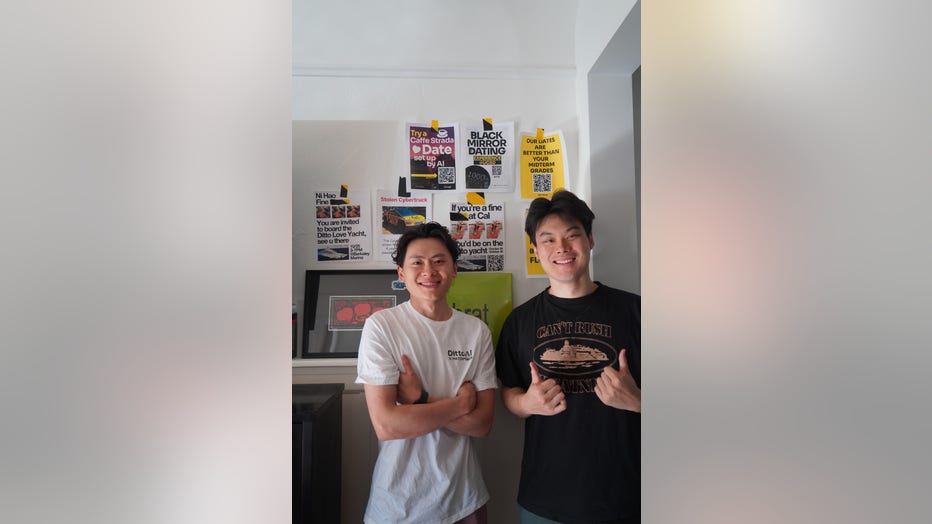
Ditto AI founders Eric Liu and Allen Wang (Ditto AI )
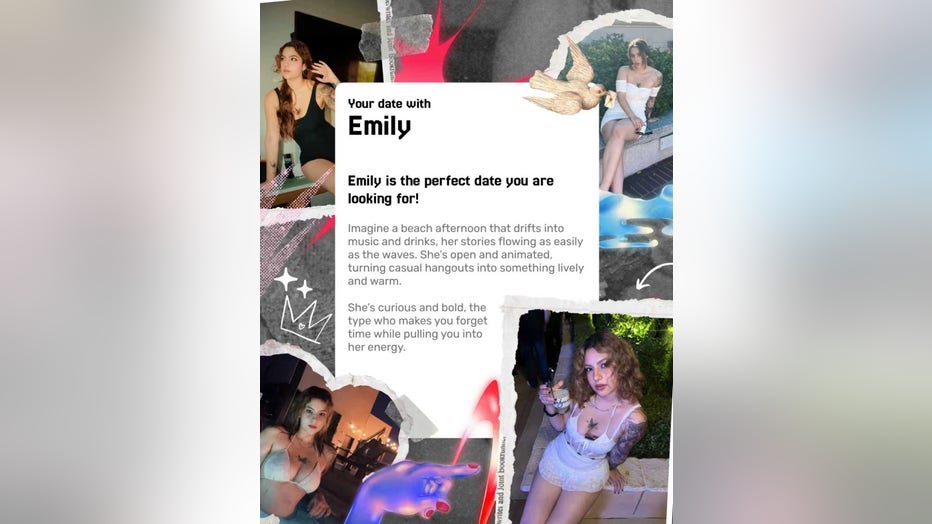
Ditto AI is a Berkeley, Calif.-based platform that's being used for dating on college campuses. (Ditto AI)