

A near-total lunar eclipse will occur this week. How best to view it
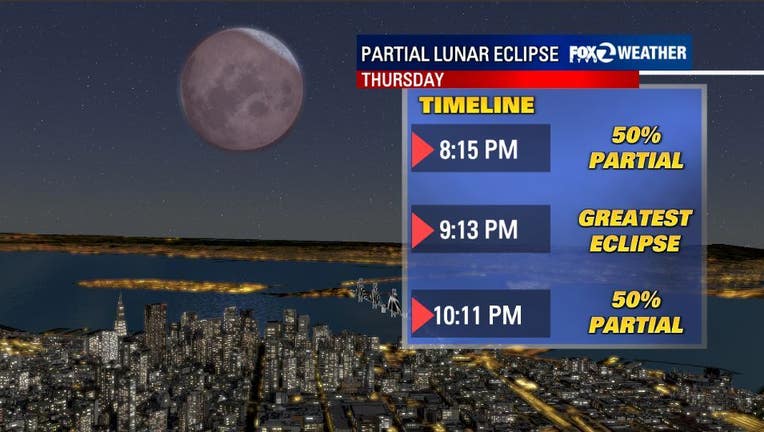
OAKLAND, Calif. - Skygazers will want to look up this week for a special celestial treat: A partial lunar eclipse will take place, and it will be an especially deep one, covering almost all of the moon with the Earth’s shadow.
What we know:
The eclipse will occur on Thursday night into early Friday, according to NASA.
"At the moment of greatest eclipse," the space agency explained, "96.3% percent of the Moon's disk is within Earth's umbra, the central part of the shadow where the Sun is completely blocked by Earth."
Peak of the eclipse
Local perspective:
Here in the Bay Area, that peak is expected to hit at 9:13 p.m. on Thursday.
According to the site Time and Date, the eclipse will unfold over a total duration of 4 hours and 23 minutes.
KTVU Fox 2 Chief Meteorologist Mark Tamayo offered a timeline:
- 8:15 p.m. - 50% partial eclipse
- 9:13 p.m. - "greatest eclipse"
- 10:11 p.m. - 50% partial eclipse
"The Bay Area is positioned nicely for it," said KTVU Meteorologist Roberta Gonzales, who added, "NASA describes the eclipsed portion as potentially taking on a ‘rusty, coppery tint.’"
Will the weather cooperate?
KTVU’s meteorology team noted that like many events that involve the night sky in the Bay Area, the weather can be tricky, and the all-too-familiar marine layer could be a factor in your viewing efforts.
SEE ALSO: NASA captures photos of Moon crater caused by SpaceX rocket part
In terms of the marine layer, Tamayo said the forecast is still taking shape.
"There could be a big batch of clouds that might move in from the South," he explained, adding, "The clouds might be more concentrated in the southern half of the Bay Area."
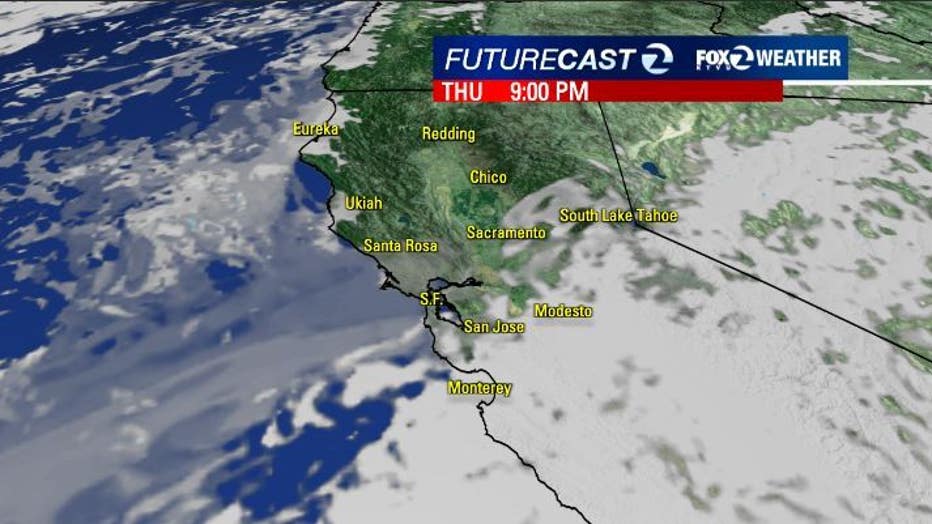
The Bay Area forecast as of Tuesday, Aug. 25, 2026.
What is a lunar eclipse?
A lunar eclipse occurs only during a full moon.
It is a phenomenon that happens when the Earth moves between the sun and the moon, casting a shadow on the lunar surface.
Unlike a solar eclipse, it can be viewed without special protective eyewear.
Best viewing practices
To optimize your chance of viewing Thursday's eclipse, you should find an unobstructed view looking toward the east or east-southeast.
"At moonrise, the moon will be very low, so hills, buildings and trees can easily block it," Gonzales noted. "By maximum eclipse it will be considerably easier to see."
How frequent are they?
While cool to witness, lunar eclipses are not rare occurrences.
"There are zero to three lunar eclipses per year (although possibly not all at the same location on Earth) where the Moon passes through at least a portion of the Earth's umbral shadow," according to the National Weather Service.
Thursday’s eclipse is the second one of 2026, and it will be the final one of the year, according to NASA.
The next one is expected in February.
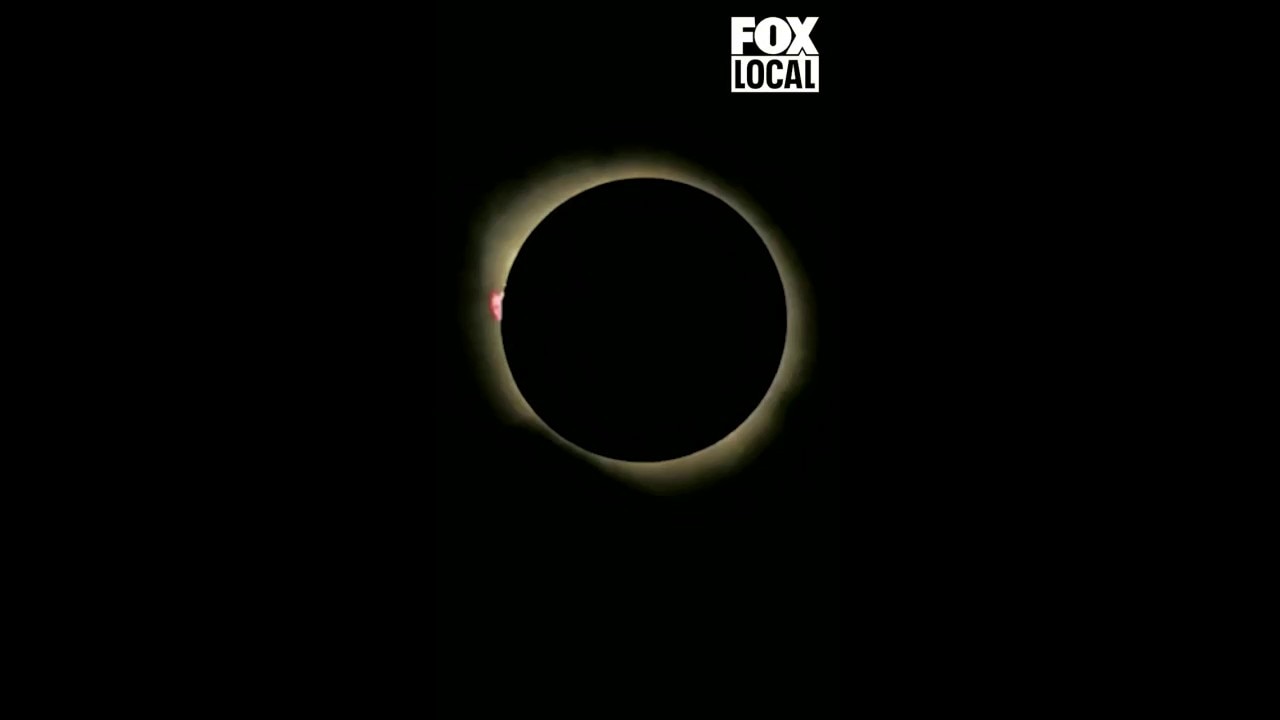
Solar eclipse reaches totality over Spain
Millions of people crowded cloudless cities and towns in Spain on Wednesday in search of the best views of a total solar eclipse, when the alignment of the sun, moon and Earth briefly plunged parts of the planet into darkness.