

Bay Area hosts one of world's largest Northern Elephant Seal mainland-breeding colonies
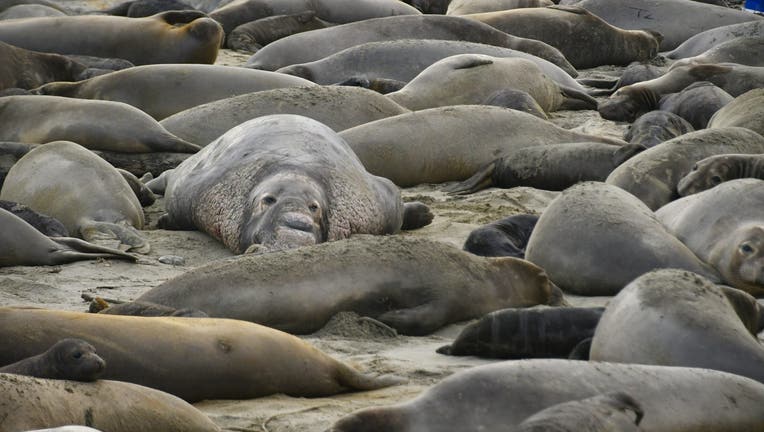
The Bay Area is home to one of the world’s largest mainland breeding colonies for the Northern Elephant Seal. Photo from a previous breeding season. (California State Park / Emmy Levy)
PESCADERO, Calif. - The Bay Area is home to one of the world’s largest mainland-breeding colonies for the Northern Elephant Seal, and breeding season for the massive pinnipeds is now underway.
What we know:
Año Nuevo State Park sits about 25 miles south of Half Moon Bay in San Mateo County. So far, more than 1,000 elephant seals have assembled on the park's reserve breeding ground, California State Parks Interpreter Susan Blake told KTVU.
And it’s still early in the season, which started last month and runs until late March.
Nature puts on a show
It’s an exciting time of the year, when Mother Nature puts on a dramatic show.
"This is the time when male elephant seals battle on the beaches for the right to mate and the females give birth to their pups on the dunes," the park said on its website.
Guided walks required
It’s also a time when reservations are required for those who want to get a glimpse of this display of survival and reproduction.
Visitor access to the Año Nuevo Coast Natural Preserve is restricted year-round, but during the breeding season, the park offers guided walks, which aim to "minimize disturbance to the animals in their natural habitat," the state park said on its website.
Volunteer docent naturalists lead the walks, which take about 2.5 hours, and cover a 3-to-4-mile hike on mixed terrain including sand dunes.
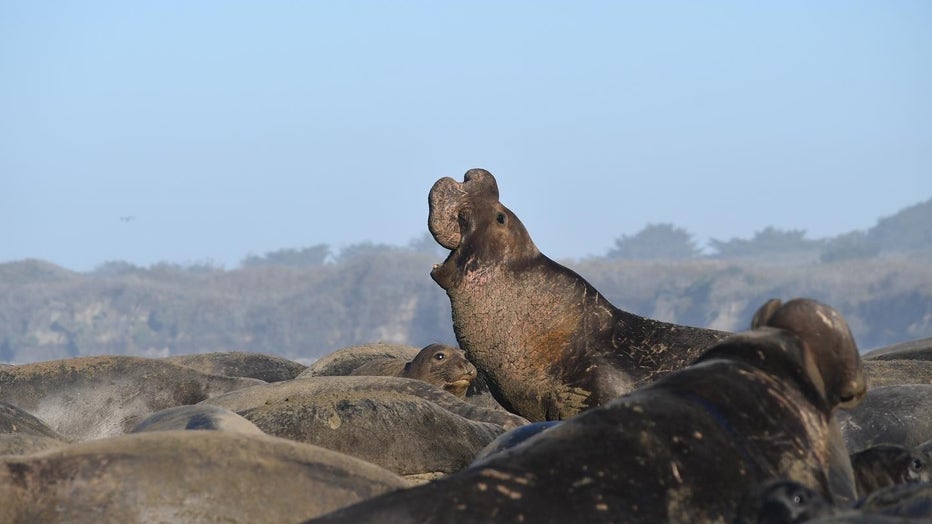
File image of Northern Elephant Seal vocalizing at Año Nuevo State Reserve in San Mateo County. (California State Park/Emma Levy)
Dig deeper:
During the season, visitors can witness an oft-noisy and chaotic scene, where the male mammals try to assert hierarchical dominance and females bring new life, and then, within days to weeks, mate again for the next breeding cycle.
Meanwhile, newborn elephant seal pups go through many stages of life over a roughly three and a half month period. The newborn bonds with its mother, nurses, and weans after about four to six weeks, before being abandoned by mom, who returns to the ocean.
The pup ultimately learns to swim and develop survival skills before it heads out to the sea itself.
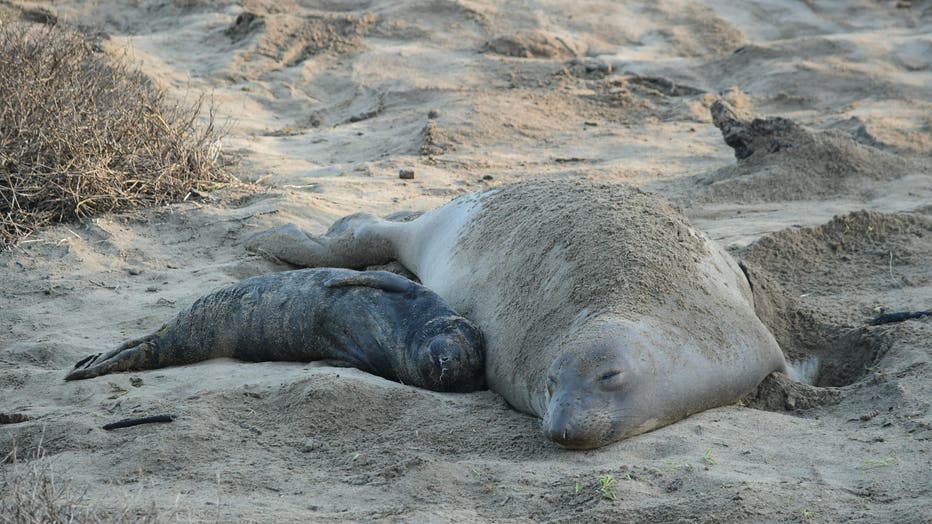
Northern Elephant Seal and pup at Año Nuevo State Park from previous breeding season. (California State Park/Emma Levy )
Once near extinction
Timeline:
The Northern Elephant seal was near extinction in the 1800s, as the large mammals were slaughtered for their blubber to produce oil.
"By 1892, only 50 to 100 individuals were left," the California State Parks website said, adding, "The only remaining colony was on the Guadalupe Island off the coast of Baja California."
The species received protected status that helped populations bounce back.
In 1955, the first sighting of elephant seals in the area was on Año Nuevo Island off Año Nuevo Point.
Park officials said the first pup was born there six years later.
By 1978, more than 870 elephant seals were born on Año Nuevo Island.
SEE ALSO: 2 caught on video throwing rocks at resting elephant seal in Point Reyes
"Males began to haul out on the mainland in 1965. A pup born in January 1975 was the first known mainland birth of a northern elephant seal at Año Nuevo," according to California State Parks.
Large breeding colonies were established on the mainland by the late 1980s.
"By 1988/1989, about 2,000 elephant seals came ashore at Año Nuevo, and the number of seals breeding and giving birth on the mainland is still increasing," the state agency said.
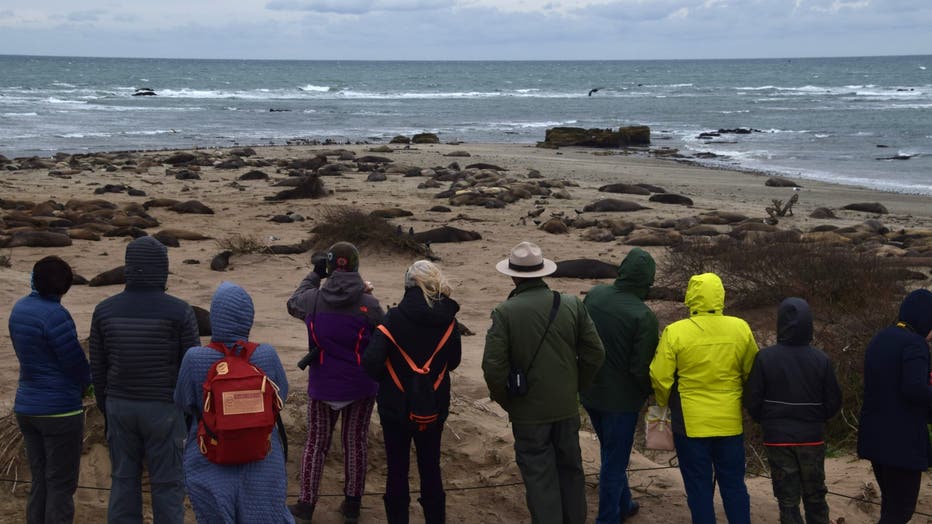
Guided walk at Año Nuevo State Park in San Mateo County. (California State Park/Mike Merritt)
What to know about the guided walks
The guided walks during the breeding season are held daily, rain or shine, according to park officials, who noted that in fact, viewing conditions are ideal when the weather conditions may not be ideal.
"Many visitors choose not to come when it’s raining, but it’s the best time to visit!" Blake shared with KTVU.
"The seals are often more active in cool wet weather," the expert explained, with the added advice, "Just be sure to dress appropriately for the weather."
Each walking group maxes out at 15 people and is offered for families, individuals, or groups.
The cost, including reservation fee, is about $11, with children under the age of 4 free. There's also a $10 per vehicle parking fee.

Why the elephant seals flick sand at Point Reyes National Seashore
Why the elephant seals flick sand at Point Reyes National Seashore.