

UC Berkeley physicist 'completely stunned' to receive Nobel Prize

Three UC professors win 2025 Nobel Prize in Physics for research led by UC Berkeley's John Clarke
UC Berkeley's John Clarke, Professor Emeritus of Physics, says he thought it was a prank call, when his phone rang around 2 o'clock Tuesday morning. It turned out to be the Nobel Prize committee in Sweden informing him he had won the 2025 Nobel Prize in Physics along with two UC Santa Barbara professors who had been his post-doc and doctoral student assistants in the 1980's when they were studying the topic of tunneling in quantum mechanics.
BERKELEY, Calif. - Three University of California professors are sharing the 2025 Nobel Prize for Physics, in recognition of the work they did at UC Berkeley forty years ago in the area of quantum mechanics.
John Clarke, a professor emeritus of physics, won the prestigious prize with two fellow physicists: Michel H. Devoret, who was a post-doc under Clarke, and John. M. Martinis, who was a doctoral student at UC Berkeley and joined the research team. The three physicists were at UC Berkeley in the 1980s when they conducted their prize-winning research. Devoret now works for Yale and UC Santa Barbara, and Martinis is at UC Santa Barbara.
"I was sitting there completely stunned. It never occurred to me anything like this would ever happen," Clark said in an interview on Tuesday.
UC Berkeley held a celebration for Clarke on Tuesday afternoon, attended by students, staff, faculty, and Clarke's daughter.

BERKELEY, CALIFORNIA - OCTOBER 07: John Clarke, an Emeritus Professor of Physics at the University of California, Berkeley, holds a lifetime campus parking pass during a celebration at UC Berkeley on October 07, 2025 in Berkeley, California. Physicis
The group will split the prize winnings of 11 million Swedish kronor (around $1.17 million).
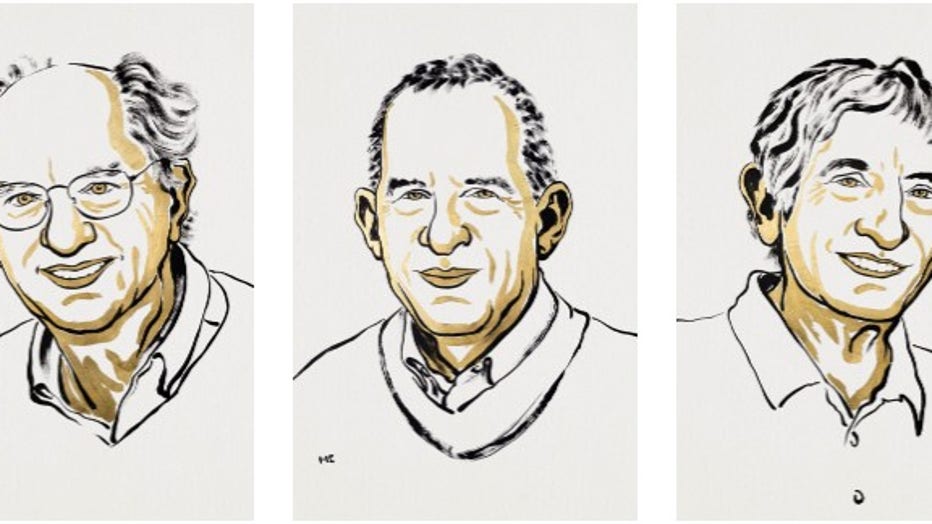
The Nobel Prize in Physics 2025 was awarded jointly to John Clarke, Michel H. Devoret and John M. Martinis "for the discovery of macroscopic quantum mechanical tunnelling and energy quantisation in an electric circuit" (Niklas Elmehed © Nobel Prize Outreach)
What did the research show?
The backstory:
Clarke, Devoret and Martinis conducted experiments in 1984 and 1985 with an electrical circuit built of superconductors. They were studying quantum mechanics using the electrical circuit.
When examining the behaviors of matter at the microscopic level, scientists had previously understood that particles could do unusual things such as pass through barriers, a quantum mechanical behavior known as ‘tunneling.'
The three scientists were able to show that tunneling can happen in circuits that are big enough to see or hold, and that quantum mechanics apply to larger systems.
A photo shared by the Nobel Prize illustrates the lesson:
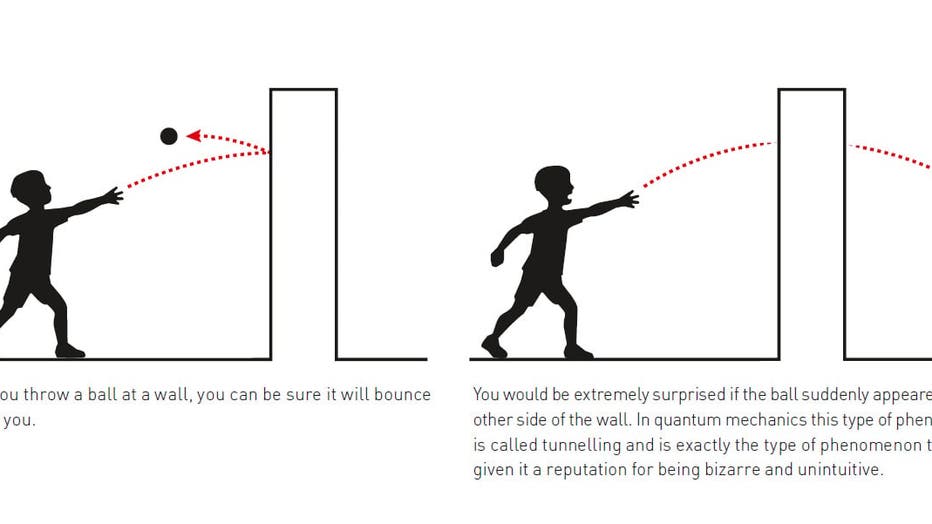
Quantum tunneling explained
"It is wonderful to be able to celebrate the way that century-old quantum mechanics continually offers new surprises. It is also enormously useful, as quantum mechanics is the foundation of all digital technology," said Olle Eriksson, chair of the Nobel Committee for Physics.
Clarke said his research received federal funding, and during these times of federal cuts to research, he hopes this will remind people why basic science is critically important.
"You have to try and do this basic science because you never know what will come out of it," he said.
Clarke also said UC Berkeley played a big role in his ability to pursue research.
"One of the things that has made the Berkeley physics department such a great place to work is the fact that we have this enormous amount of support," Clarke said. "And that's absolutely crucial."
The amount of lab space he had was crucial.
"[Berkeley] provided me with a lot of lab space, so I had space to employ a dozen or so graduate students and postdocs," he said.
His message to young researchers?
"There are very few projects that I started on that I, in fact, completely gave up on, and I think it's a matter of trial and error and patience and understanding — if it doesn't work, why it doesn't work."
For more details on the prize-winning research, please visit the Nobel Prize site.
The Nobel Prize ceremony will be held in Stockholm, Sweden on December 10, 2025.

BERKELEY, CALIFORNIA - OCTOBER 07: John Clarke, an Emeritus Professor of Physics at the University of California, Berkeley, speaks during a celebration at UC Berkeley on October 07, 2025 in Berkeley, California. Physicists John Clarke, Michel H. Devo
The Source: Nobel Prize, interview with UC Berkeley's John Clark.