

This over-the-counter spray could protect you from COVID-19: study
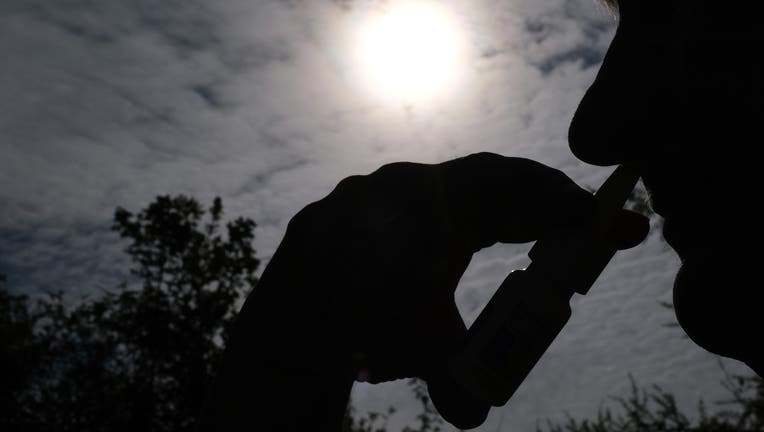
15 April 2025, Baden-Württemberg, Stuttgart: A woman sprays a nasal spray against a pollen allergy in the countryside (staged scene). The sun is shining in the background. Photo: Bernd Weißbrod/dpa (Photo by Bernd Weißbrod/picture alliance via Getty
SAARBRÜCKEN, Germany - New breakthrough research suggests that a common, over-the-counter nasal spray used to treat allergies may protect against COVID-19 and potentially other respiratory viruses.
What we know:
The study by researchers at Germany’s Universität des Saarlandes determined that azelastine nasal spray significantly reduced the risk of Covid infections.
Azelastine is sold under brand names including Astepro Allergy. The drug is also available by prescription.
How it works
Researchers said the antihistamine spray works locally, interfering, inhibiting, and suppressing the various processes in which the coronavirus enters the body – through the nasal mucosa, the tissue that lines the nasal cavity.
What they're saying:
"The nasal mucosa is the primary site of viral entry," lead researcher Professor Robert Bals explained to KTVU in an email, adding that azelastine appears to "reduce the chance of successful viral replication and spread at the portal of entry."
Bals said during the pandemic, researchers had evidence from small clinical trials as well as sources including labs and computer-based studies that suggested the potential benefits of the spray against Covid and other respiratory viruses.
So, based on the earlier findings, they conducted this larger trial to see if "a safe, widely available medication could also be used prophylactically to prevent infections."
Dig deeper:
The study involved 450 healthy volunteers in a double-blind, placebo-controlled clinical trial.
227 people were in the treatment group that used an azelastine nasal spray three times a day over a nearly two-month period.
223 participants in the control group used a placebo spray three times a day.
The Findings
"During the observation period, 2.2% of the participants in the azelastine group became infected with SARS-CoV-2; in the placebo group, it was 6.7%—three times as many," Bals explained.
All infections were confirmed by highly effective PCR or polymerase chain reaction testing, researchers noted.
They also pointed out that the group that received treatment showed fewer symptoms of Covid and had an overall lower number of confirmed respiratory infections.
There was another unexpected benefit, according to researchers. The azelastine group had fewer instances of rhinovirus infections, a viral illness that causes the common cold and another major cause of respiratory illness.
The study showed 1.8% of the participants that used azelastine developed a rhinovirus infection, compared to 6.3% in the placebo group.
COVID-19 infections up
The findings come as Covid-19 infections are up in California and in the Bay Area.
Local perspective:
The latest figures show the test positivity rate in the Bay Area at 15.5% from Aug. 24 to 30, up almost 2.5% from the previous week. A year ago in the same period, the test positivity rate stood at about 7.7%.
State data also showed wastewater in many parts of the Bay Area with high levels of the virus.
Vaccine confusion
The findings about azelastine's potential benefits also come amid confusion over the policies on who can and should get the vaccine.
Last month, the Food and Drug Administration rescinded the emergency use authorization of Covid vaccines and narrowed the list of those who have easy access to the shots. Under the new rules, adults 65 and older and younger populations that have underlying conditions that put them at high risk can receive the vaccine at most pharmacies with insurance coverage.
"FDA has now issued marketing authorization for those at higher risk: Moderna (6+ months), Pfizer (5+), and Novavax (12+). These vaccines are available for all patients who choose them after consulting with their doctors," Health and Human Services Secretary Robert F. Kennedy Jr. said in a posted on X on Aug. 27.
Earlier this year, Kennedy, removed key groups from those the Centers for Disease Control and Prevention previously recommended for the vaccine.
"In May 2025, HHS Secretary Robert F. Kennedy Jr. announced that COVID-19 vaccines were removed from the CDC’s recommended immunization schedule for healthy children and pregnant women," the department website states.
SEE ALSO: New FDA approved eye drops for vision is coming soon
The CDC's Advisor Committee on Immunization Practices (ACIP) is scheduled to meet next week to discuss COVID-19 vaccines.
Critics said the federal government has only created confusion on the matter and some do not have confidence that ACIP's meeting will provide the clarity the public needs.
"It’s impossible to explain with assurance the new rules as HHS has created confusion and chaos in communicating policy. And the Advisory Committee on Immunization Practices (ACIP) will not be meeting until September 18–19," infectious diseases and vaccinology expert Dr. John Swartzberg said in a UC Berkeley Public Health interview. "I suspect they will add further confusion along with disinformation," the UC Berkeley clinical professor added.
California guidelines
The California Department of Health has provided more defined guidelines saying, "CDPH continues to recommend that everyone age 6 months and older should have access and the choice to receive COVID-19 vaccines."
The agency also stressed the importance of protection for high-risk groups, including infants and toddlers, pregnant women, and others at risk of serious disease.
The state health agency added it is working with the newly formed West Coast Health Alliance, a partnership involving California, Oregon, Washington and Hawaii to continue promoting vaccine access.
Extra protection
The new research on azelastine could be a breakthrough in COVID-preventive measures.
Bals said ultimately, "azelastine could serve as an easily accessible, over-the-counter adjunct to reduce infection risk—particularly during periods of high viral circulation, in crowded settings, or for people at elevated risk."
What's next:
Researchers said they’re planning the next phase of the clinical trials, designed to be larger in scale and include more diverse populations, to confirm the efficacy of azelastine as well as determine the drug’s potential benefits against broader respiratory viruses.
Not a vaccine replacement
While the nasal spray could be a game changer, Bal emphasized it would not serve as a replacement for vaccines.
"Azelastine would be considered a supplementary measure," Bals said, adding, "Vaccination remains the cornerstone of COVID-19 prevention. Nasal prophylaxis may add an extra layer of protection, but it cannot substitute for systemic immunity."

COVID-19 vaccine access limited, leaving many frustrated, confused
Confusion is growing around the latest COVID-19 vaccine rollout, with changing federal rules and restricted eligibility leaving many Californians unsure if they qualify or where to get the shot.
This story was reported from Oakland, Calif.